
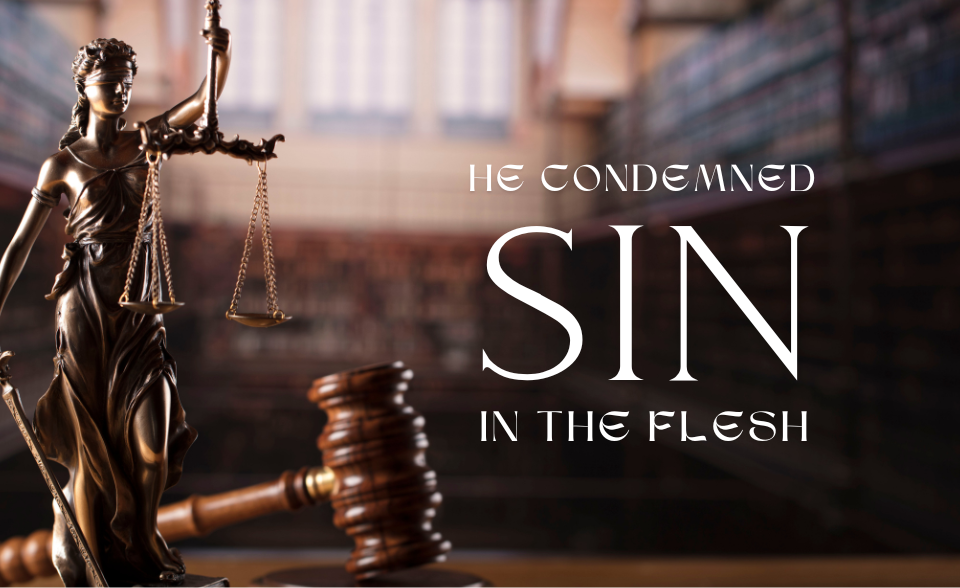
For God has done what the law, weakened by the flesh, could not do. By sending his own Son in the likeness of sinful flesh and for sin, he condemned sin in the flesh, in order that the righteous requirement of the law might be fulfilled in us, who walk not according to the flesh but according to the Spirit.
Romans 8:3-4
During my last semester of college, I interned at a Public Defender’s office. My paralegal studies had taught me about our legal system and how to assist an attorney in a court case, but I was thoroughly unprepared for what the law looked like in real life.
My job was to help the public defender interview defendants before their arraignments. I followed the attorney down into the courthouse’s basement, where the defendants entered through a tunnel connected to the county jail. The judge sat behind plated glass with armed guards stationed around the room. About fifty defendants in orange jumpsuits filed into the courtroom and lined the perimeter. We met with each of them to review their charges and gather their pleas before they went before the judge.
We asked each one, “Are you entering a plea of guilty or not guilty?”
Limits of the law
To say I was terrified of the whole scene would be an understatement. Everything about the setting and the proceedings in that fluorescently lit underground courtroom reminded me of the seriousness of violating the law. I remember looking at some of the defendant’s vacant stares and wondering why they didn’t look more afraid. Didn’t they know how serious this was?
Sadly, many of them were mentally ill or still under the influence, and others were all too familiar with this process. Most defendants, even if they’re guilty, enter a not-guilty plea to exercise their right to due process. A not-guilty plea buys them time for evidence to emerge and for negotiations to take place. The guilty aren’t hoping the law will reform them, but that with time, it might, somehow, excuse them.
Even though that setting would’ve scared me straight, never, while I was down there, did anyone suggest that these arraignments would change a defendant’s life. The proceeding’s purpose was far more limited. It simply brought the defendant face-to-face with the law. Nothing in that courtroom addressed the sinful behavior that led the defendants there. And no one ever said, “Your honor, more than punishment, what I really need is a new heart that loves and upholds your law.”
In fact, the court doesn’t concern itself with whether you agree with its laws; it only demands that you keep them. So, while the judge has the power to condemn those under the law, he has no power to create obedience or love for the law in those who stand before him.
The weakness of our flesh
God’s law stands like a judge’s bench before us, and God himself sits as the righteous Judge. He knows every statute by heart, for he wrote them all, and he knows every defendant who stands before him.
All his laws are holy, righteous, and good (Rom. 7:12), but even when we obey him, our motives aren’t always pure. The law helped us know what sin is and what God’s righteous law required of us, but it still could not make us holy (Rom. 7:7). Even when our souls delighted in God’s law, another law of sin still wages war in our minds and bodies (Rom. 7:22-23). The standard is impossibly high. Not only do we need clean hands, but pure hearts (Ps. 24:4). Standing before God the judge, and his holy law, we can only plead “guilty.”
Jesus took on flesh
That’s why Paul can say, without diminishing the law, “For God has done what the law, weakened by the flesh, could not do” (Rom. 8:3). The law rightly condemns us, and so God sent his own Son to condemn sin in the flesh (4). He came in the likeness of human flesh and perfectly fulfilled the law.
Paul is not suggesting that the likeness of human flesh meant Jesus merely appeared human. Rather, he shared all our human weaknesses, yet never shared our guilt. The word ‘likeness’ matters because it reveals the dual nature of Jesus as both fully God and fully man. He walked on earth for thirty-three years and felt hunger, weariness, sorrow, temptation, and suffering, yet he never sinned.
Because he was sinless, he fulfilled the law perfectly. And because he lived in real human flesh, God accomplished through him what the law could never accomplish in us. In his great mercy, the judgment the law required didn’t fall on us; instead, it fell on Christ. Therefore, those who are in Christ Jesus are now declared “not guilty.”
Now we can live according to the Spirit
So why did Jesus do all this for us? Verse four, “in order that the righteous requirement of the law might be fulfilled in us, who walk not according to the flesh, but according to the Spirit.” God’s purpose in the cross was not only to forgive us, but to give us the Spirit and enable us to live in accordance with his will.
Apart from Christ, the law’s righteous standard could never be met. But united to Christ, that same righteous requirement is now fulfilled in us, not by the flesh striving to obey, but by the Spirit empowering us from within. The law demanded obedience, and the Spirit supplies the ability. What the law commanded but never produced, God now satisfies through his Spirit.
The law and grace
In that basement courtroom, the law had the first and last word. Pleas were entered, but no one left changed. The law could only expose what was wrong; it could never make anyone right.
If you are in Christ and frustrated by your flesh, remember that Jesus defeated sin in his flesh for you. God sent his Son to condemn sin in the flesh and fulfill the law on our behalf. We still carry the weakness of our flesh, but now the same Spirit who raised Jesus from the dead lives in us, shaping us to be more like him.
Now we can stand before the judge in full confidence and enter a plea of “not guilty.” Not because of our righteousness, but because of Christ’s.
This court proceeding changes everything—not only our legal status, but our very nature from the inside out. Your lawlessness brought you into the courtroom, but Christ’s perfection carries you out free.
Oh, what grace!
Cara
P.S. This is the second post in a series on Romans 8. You can read about Romans 8:1-2 here.
P.P.S. Do you want to memorize Romans 8 with me? Grab these free Scripture Memory Cards to help you write these glorious words on your heart.
One Response
A new appreciation of grace and mercy.
Thank you, Cara