
I know I’ve felt this way before, and I don’t like it. It’s that low-grade dread I used to feel on Sunday nights before a new school week began. Back then, when I looked ahead, everything felt uncertain. The more I thought about what could go wrong, the more I convinced myself that it probably would. Thankfully, that’s not my normal state of mind, but I’ve been feeling it again lately, and I’m trying to discern why.
Maybe it’s hormonal, or the midterm results, or the fact that my kids are moving up and moving out. So much is changing all around me. I’m not sure of the root cause, but whatever it is, it’s had me in a serious funk lately. Plus, the ways I usually deal with stress haven’t helped much. Writing has been a chore. I’m bored with my exercise routine. And even my quiet times have been a struggle. I’m just keeping it real, friends.
But there’s one thing I keep coming back to, and every time I do, it changes my perspective. It helps me look beyond present uncertainty to a future I can be sure of. It’s a new-to-me theological term, but an old, old doctrine that runs from Genesis to Revelation. It addresses how we see reality now, but what we’ll see in the future. It concerns both our physical and spiritual vision—what we will see with our eyeballs and what we see now with the eyes of faith. It’s what makes heaven heaven, and it’s called the beatific vision.
The Beatific Vision
Even if you’ve never heard the term ‘beatific vision,’ you’re probably familiar with it. Beatific literally means “happy” or “blessed.”
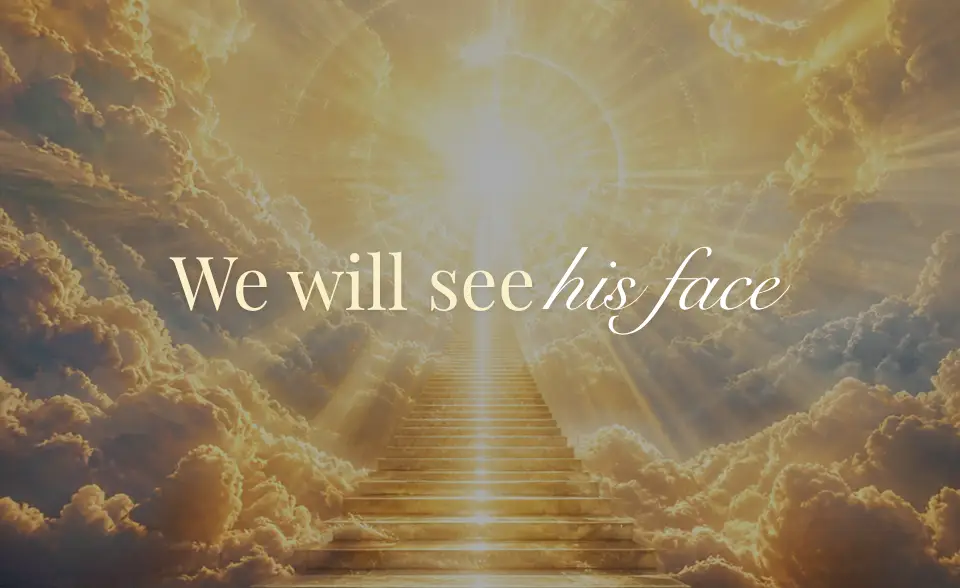
When you envision heaven, what comes to mind first? Is it the winged angelic creatures, streets of pure gold, pearly gates that never close, rivers like sparkling glass, or the tree of life that always bears fruit (Read Rev. 21-22)? I’m certain those sights will utterly undo us. But do you know what will make your soul blissfully, completely, and overwhelmingly happy and blessed? It will be when your faith is made sight, and you see God.
This beatific and happy vision is the believer’s blessed hope. If you are in Christ, this is what your soul wants most. This is the testimony of all the saints, starting with our first parents. As a young believer, I remember lamenting all that Adam and Eve forfeited by their sin—perfect environment, disease-free bodies, and sinless relationships. But I didn’t realize until later that their biggest loss—and what humanity has longed for ever since—was unhindered fellowship with God. We were made to walk with God as they did in the cool of the day, and behold his glory.
Though our first parents forfeited that unhindered fellowship, God graciously continued to reveal himself, giving his people glimpses of his glory throughout the Bible.
Seeing God Changes Us
Moses enjoyed special access to God’s presence unlike anyone else, yet even though he spoke with God as a man speaks to a friend, he longed for more. That’s why he boldly asks God to show him his glory (Ex. 33:18). God responded that no man can see his face and live, but he graciously placed Moses in the cleft of a rock and let him see only his back as God passed by. Moses couldn’t behold the fullness of God’s glory and live, but his encounter with God changed him. When he came down from Mount Sinai, his face shone so brightly that he had to wear a veil.
Isaiah saw something he could hardly describe. He saw Yahweh seated on a throne, and the train of his robe filled the temple with glory (Isa. 6). How did Isaiah respond to this glimpse of God in heaven’s throne room? He said, “Woe is me!” Suddenly, he became painfully aware of his own sinfulness and his need for cleansing.
Job’s story is one of suffering. But his ultimate hope wasn’t that God would reverse all his misfortune (though God graciously did!). Instead, he looked forward to a day beyond his suffering when he would see God. “After my skin has been thus destroyed, yet in my flesh I shall see God” (Job 19:26, emphasis mine). And David, for all his military exploits and earthly fame, longed for only one thing: to gaze upon God’s beauty in his temple (Ps. 27:4).
The Old Testament veiled what the New Testament reveals more fully in Jesus Christ. The veil Moses wore becomes a picture Paul uses to explain the contrasts between the old and new covenants. But in Christ, the veil is removed. We now behold his glory with unveiled faces through faith, and as we do, we are transformed into his likeness, from one degree of glory to another (2 Cor. 3:15-18).
By God’s grace, we behold his glory in the gospel with a clarity that outshines what even Moses and Isaiah saw. Though we did not witness Christ’s earthly ministry, we now behold him with eyes of faith. And someday our physical eyes will see the glorified Christ, whose radiance Peter, James, and John saw on the Mount of Transfiguration—shining in the full strength of his glory!
Samuel G. Parkison, in his book on the beatific vision, To Gaze Upon God, describes how transformative this vision is to all who see it. He writes, “There is a real sense in which John ascended the mountain with Christ and Peter and James and never came down. All that John wrote was composed, as it were, within the light of Christ’s transfigured glory.”
Once we glimpse God’s glory, whether in the cleft of a rock, the throne room of heaven, or the radiance of Jesus’ face, we cannot remain unchanged!
Our Faith Will Be Made Sight
Seeing God and being changed is the pattern of all the saints. The same John, who went up the mountain but spiritually never came down, assures us of this future transformation.
“Beloved, we are God’s children now, and what we will be has not yet appeared; but we know that when he appears we shall be like him, because we shall see him as he is. And everyone who thus hopes in him purifies himself as he is pure” (1 John 3:2-3).
So friends, this is the telos—the ultimate end and goal—for which you and I were created. We were created to see God!
Maybe it would do our eyes of faith some good to think about this more often. When worries about this life and all the things we cannot change begin to consume us, we can instead consider how we will be changed when we see God face to face.
We can be assured that history is barreling toward this resolution, just as God planned. What started in the garden will one day be fulfilled in the holy city. What Adam forfeited, the better Adam restored. Nothing can thwart his plan, and in his kindness, he will bring us to the day our faith becomes sight.
Our Future is Bright
So, I’m preaching these truths to myself, and I hope they encourage you, too. How can we have a happy vision for the future? Remember our end, which is really just a beginning. Someday, we’ll see Jesus, and we’ll be happy forevermore.
Whether you’ve heard of it before or not, the glorious truth of the ‘beatific vision’ is woven throughout your Bible. What was lost in Genesis 3 is restored in Revelation 22. We would do well to stamp this truth on our hearts today, for someday its reality will be stamped on our foreheads. “They will see his face, and his name will be on their foreheads” (Rev. 22:4, emphasis mine).
Whatever today may bring, dear friends, lift your eyes. Your future is unbelievably bright and happy.
Cara
Related Posts:
- How Holy Leisure Helps You See More Clearly
- 20 Bible Verses About Trusting God When We Cannot See
- Lessons From Bartimaeus: 5 Eye-Opening Ways to See Your Need
P.S. How can you prepare your heart for the beatific vision? Spend time with him in his Word. Grab a copy of my book, The Pursuit of Holy Leisure: Enjoying God in Everyday Places, to accompany your study.