
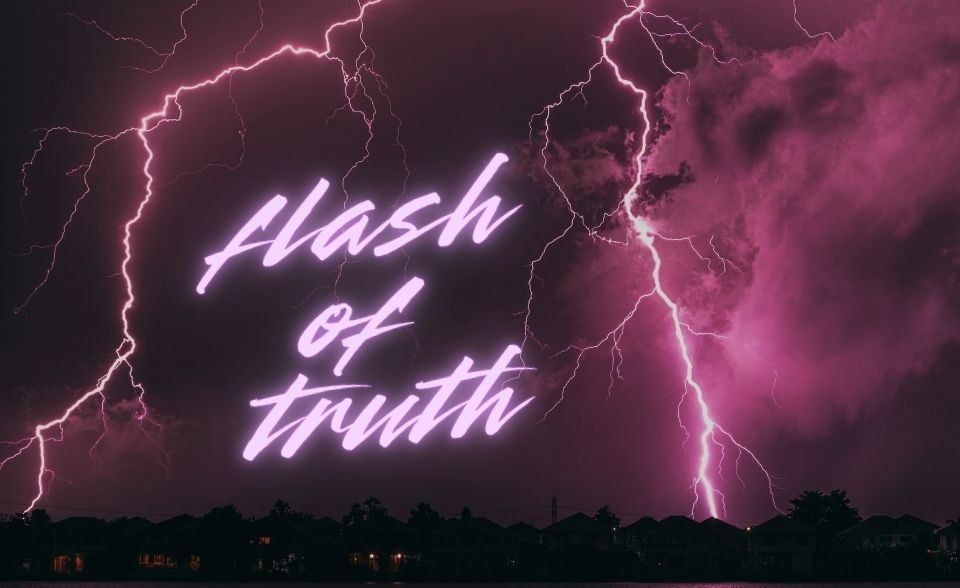
It all happened so quickly. At first, we weren’t sure what had happened. We saw it out of the corner of our eyes as we drove along the freeway. A flash of light lit up the night sky, and a millisecond later came the explosive crack and boom. “What was that?!” My husband, Tim, adjusted his rear-view mirror, and we turned to see through the back window. Against the backdrop of the night sky, a telephone pole stood like a pillar of fire—the target of a phantom lightning bolt.
Unnerved at how close that was, we marveled at the lightning’s power and speed. That poor telephone pole never knew what hit it—but the aftereffects were undeniable. It all happened in a flash, just like when Truth strikes and illuminates a darkened heart.
Flash of Truth
Have you ever experienced a lightning bolt of truth? One moment you didn’t believe in Jesus, and then after the truth landed in your soul, you did? Or at one time you believed something untrue, but when the truth was presented, you saw it clearly—if only for a moment. Even if not yet embraced, its presence was undeniable and couldn’t be unseen. Augustine called this a “flash of truth” (Augustine, On the Trinity, VIII. 3).
A flash of truth is enlightening and exciting, but it can also be unsatisfying. There’s something there, but you can’t hold it because it comes as quickly as it goes. That’s because we’re not meant to admire the truth fleetingly, like a strike of lightning. We can’t sustain our “seeing” of this truth on our own. Instead, we were made to abide in the warmth of its light—letting it show us the way.
Unhurried abiding allows us to see beyond the flash, and this is the heart of holy leisure. When we pursue holy leisure, not only in our quiet times but in our creative endeavors, we rest in the One from whom all truth comes. The writer’s task is not only to see the flashes of truth but to dwell with them long enough to be changed by them. As we behold Christ, the source of all that is true, good, and beautiful, we find that truth is not simply something to understand, but Someone to enjoy.
Truth, then, is not vague, hard to define, or hard to find. Jesus said, “I am the way, and the truth, and the life. No one comes to the Father except through me” (John 14:6, ESV). He took on flesh and dwelt among us, and his glory was (and is) visible (John 1:14). Jesus’ truth claim is that he is the truth. He defines what truth is by his life and by his Word. So then, the flashes of truth we see and experience in this life find their origin in him.
An invitation to see
Have you ever seen a dramatic photo of lightning in the split-second it strikes? Our eyes trace the squiggly line from its source to the point of contact, from storm clouds to telephone poles. The first obligation of the Christian writer is to see the flash of truth. Our job isn’t always to explain the flash or trace the line, but to invite others to see it too.
The flash of truth often catches the writer off guard before it does the reader. This process requires looking at something longer or harder than feels normal or comfortable. It means we resist the temptation to flatten something complex, moralize prematurely, or reach for a tidy conclusion before its time. We have to stay in the moment of discomfort long enough for the resolution to be as much of a relief to us as it is to the reader.
The writer writes truthfully by staying in the discomfort long enough so that the relief, when it comes, is welcomed. Remaining faithful to the truth means that, just like the gospel, the good news is only good, because the bad news is really that bad.
5 ways to write truthfully
The discomfort of writing truthfully requires that we seek truth in every word and sentence. Seeing, at some point, transitions to saying. Ernest Hemingway said to overcome writer’s block, “All you have to do is write one true sentence. Write the truest sentence that you know.” That may sound simple, but it’s not easy. Christian writers not only want to get true and good words on a page, but to write in a compelling and winsome way.
The goal is not only to write one true sentence, but one true sentence after another. We want to earn our readers’ attention and trust from the first sentence to the last. Here are five questions we can ask ourselves in our quest to write truthfully.
- What truth am I pointing my readers to? Have I presented it compellingly while remaining faithful to not add or subtract from God’s truth?
- Am I reporting what’s actually there, or what I wish were there, or what I feared was there?
- Does sin or darkness feel real and genuinely terrible—or have I made it easy to dismiss?
- Did I stay in the difficulty long enough to render it honestly, or did I rush to the resolution?
- Would a reader who has actually lived this recognize and relate to it?
Whether you trace the line or point your readers to it so they can see it for themselves, your job is not to resolve what God has left unresolved. Rather, you must focus on seeing clearly and writing truthfully and faithfully.
Eyes to see
Flashes of truth come quickly and unbidden, and we never know exactly when or where they’ll strike. But the Spirit of God is always at work, revealing truth in mysterious and creative ways, and always in keeping with his Word. He may even choose to use your words to flash truth into a reader’s soul.
So, writer friends, learn to recognize the flash. Every true thing can be traced back to its source, Truth incarnate, Jesus Christ. The Christian writer does not manufacture the light nor control the results the light brings. Rather, she crafts her words to point others to the True One. This is the Christian writer’s first and greatest obligation—to see and testify to the Truth.
Write faithfully. Write beautifully. Write from rest.
Cara
Related Posts:
- 20 Bible Verses for Creatives and Makers
- 20 Bible Verses About Trusting God When We Cannot See
- Do Not Be Troubled: Jesus is the Way
- Jesus is the Light of the World & His Light Brings Hope
- The Most Important Doctrine You’ve Never Heard Of
- Other Articles On Writing
P.S. Do you long for your writing to be good, true, and beautiful, and come from a place of rest? Do you long to write from a place of holy leisure? Then, download “The Writer’s Examination Guide.” It will walk you through questions to ask yourself as you seek to write faithfully, beautifully, and from rest.